

HubSpot is a powerful CRM and customer platform for sales, marketing, service, automation and reporting. But if a small team only needs to answer customer questions without losing messages, a full CRM can be more than the situation requires. In this article, we compare HubSpot with a lighter option: a Telegram inbox where customers write to a bot and the team replies from one private Telegram group. This is not about which product is more powerful. It is about which workflow is easier to start and maintain for a small business.
Why small teams often start with HubSpot
When customer messages start getting lost, choosing HubSpot can feel like a mature step. It is a well-known platform with CRM, contact management, sales tools, marketing features, customer service tools and automation. For companies with a real sales process, multiple touchpoints, pipelines and reporting needs, that can make a lot of sense. HubSpot is built to help teams organize contacts, track deals and connect different parts of the customer journey.
The problem appears when a small business tries to use a full CRM for one narrow task: answering customer questions. A customer asks about an order, a delivery date, a refund, a product detail or a basic service request. The team does not always need a pipeline, a deal stage, a complex contact record or a long internal process for every small message. If the tool feels heavier than the problem, people quietly go back to Telegram, WhatsApp, email threads and screenshots.
Sometimes the problem is not CRM - it is scattered messages
Many small teams do not have a sales-process problem first. They have a message-flow problem. Customers write to the founder personally, to an old chat, through a website button, in WhatsApp, in Telegram, through social media or to whoever answered last time. Then the team starts forwarding screenshots, asking who replied, and searching for the message that was supposed to be answered yesterday.
That is not a sign that the business immediately needs a large system. It may simply need one clear place where customer conversations arrive and where the team can reply. Personal chats are convenient at the beginning, but they do not scale well. Once several people need to help, the founder’s private messenger becomes a bottleneck. A lightweight Telegram inbox solves this smaller problem before the business commits to a larger CRM setup.
What GramDeskBot does differently
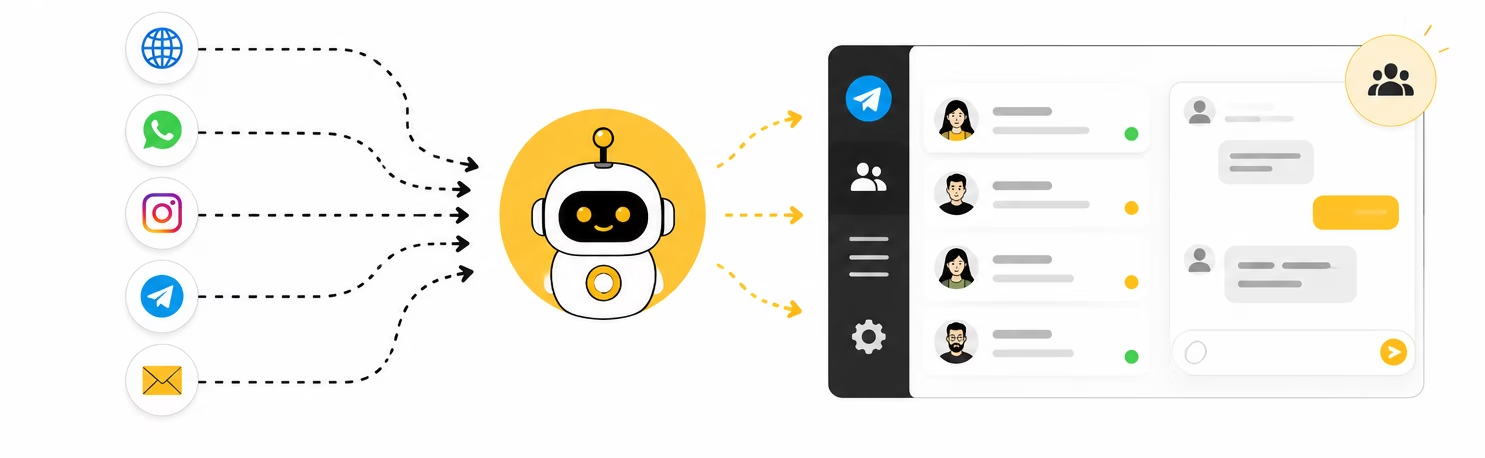
GramDeskBot should not be positioned as another CRM. It is a Telegram inbox for customer support. Customers write to your Telegram bot, and your team replies from a private Telegram group. For the customer, the experience is simple: they open the bot, send a message and get a reply. For the business, conversations stop being trapped in one person’s personal account.
This is useful for small teams because it works where the team already spends time. There is no need to open another dashboard just to answer a delivery question or a simple support request. The Telegram group becomes the shared workspace for support. GramDeskBot is also designed around a simple pricing idea: about $3 per bot per month, without charging for every teammate. That matters when a founder, assistant, manager or partner may all need to help with customer replies.
HubSpot and GramDeskBot solve different problems
HubSpot makes sense when you need a CRM: contacts, deals, lifecycle stages, tasks, automation, reporting and a broader customer platform. If your sales process has multiple steps and you need to measure the full customer journey, a CRM can be the right choice. It gives structure to sales and marketing operations that would otherwise become difficult to manage.
GramDeskBot makes sense when the job is simpler: receive customer messages and answer them from one place. It does not try to replace every CRM feature. It solves the communication layer for small support workflows. The question is not “which product has more features?” The better question is “which workflow will the team actually use every day?”
Example: a small online store
Imagine a small online store that receives 10 to 20 customer questions per day. People ask about shipping, returns, product availability, payment, order status and small details before buying. At first, the founder answers everything personally. Then an assistant joins. Then some messages are in Telegram, some in WhatsApp, some in old threads and some are forwarded as screenshots. The business is not broken, but the support flow is messy.
HubSpot can be useful if the store is ready to build a broader sales and marketing process. But if the immediate problem is simply to collect support questions in one place, a Telegram inbox may be easier. The customer writes to the bot, the message appears in the support group, and someone on the team replies. It is not a full operating system for the company. It is a practical first step toward organized support.
Example: a freelancer or small service team
A freelancer often starts with personal chats because it feels natural. Clients write directly, files arrive in the same messenger, questions appear between personal conversations, and old clients come back months later. After a while, Telegram becomes a hidden business system, but without structure. It is fast until it becomes too crowded.
A full CRM can feel too formal for this stage. The freelancer may not need pipelines, reports and complex fields. They need a boundary between personal life and client communication. A Telegram bot creates that boundary. Clients get one link for work-related questions, and replies happen from a dedicated workspace. If the freelancer later becomes a small studio, an assistant or project manager can join the group without taking over the founder’s personal inbox.
This is not “CRM versus bot”
The better framing is not a fight between tools. A CRM is useful when the business needs a structured sales and customer management process. A Telegram inbox is useful when the main problem is that customer conversations are scattered across personal chats and nobody has a clear shared view. These tools can even work together later. A team may start with a Telegram inbox for support and add a CRM when its sales process becomes more complex.
Small businesses should not choose a tool only because it looks more serious. The most serious tool is the one the team actually uses. If everyone already works in Telegram, it can be smarter to organize support inside Telegram before introducing a heavier system. Simplicity is not a weakness when it helps the team reply faster.
Conclusion: when a Telegram inbox is enough
Choose GramDeskBot when you need a simple way to handle customer support without a heavy CRM. Customers write to a Telegram bot, and your team replies from a shared Telegram group. Personal accounts stay private, messages are easier to track, and teammates can help without being billed as separate support agents.
Choose HubSpot when you need a broader CRM for sales, marketing, reporting and automation. But if your first problem is lost messages and slow replies, a Telegram inbox may be the easier first step. Sometimes a small business does not need a bigger system. It needs one clear door where customers can ask for help.
Learn more: https://gramdeskbot.com/