

Digital service support without a CRM often starts in the simplest possible way: customers write in Telegram, the team replies manually, and important questions live in the memory of one or two people. For a small SaaS, VPN service, subscription product, bot, online tool or private community, that can be normal at the beginning. A full CRM feels too heavy, too expensive and too early.
The problem appears when customers start asking about payments, access, setup, bugs, refunds, limits and request status. Personal chats quickly turn into a pile of small fires. A more practical first step is not to implement a large helpdesk too early, but to collect requests in one clear Telegram inbox where the team can see conversations and reply without chaos.
| What happens | Why it becomes a problem | Simpler first step |
|---|---|---|
| Customers write to the owner’s personal Telegram | Conversations get lost, work mixes with personal life, and adding a second helper is hard | Give customers a Telegram bot instead of a personal contact |
| Questions arrive from many places | Payments, access, bugs and refunds are scattered across old chats and comments | Send incoming requests into one private team group |
| The team is small and a CRM feels excessive | You do not need pipelines, reports, complex roles or a week of setup | Use a lightweight shared inbox instead of a heavy CRM |
| Customers need fast answers | For a digital service, delay can mean a lost payment or an angry user | Reply where the team already works every day: Telegram |
Why digital service support gets chaotic so quickly
Digital products have an awkward trait: the product can be fully online, while support remains completely manual. One user paid but did not receive access. Another cannot set up the service on a phone. A third wants to extend a plan. Someone lost a link. Someone writes “nothing works” without explaining what exactly is broken.
At first, this feels manageable because there are not many messages and the founder almost knows every customer by name. The real problem starts much earlier than “a thousand tickets per day”. It starts when there are just enough messages for one important conversation to be forgotten.
A customer writes in the evening. A manager sees the notification, thinks “I will come back to this”, opens another chat, and by the morning that request is buried under new messages. In a digital service, that person may have already paid and still has no access. What could have been a loyal customer becomes a support incident for no good reason.
Small teams usually patch this manually. One person replies from personal Telegram, another asks for a screenshot, a third occasionally joins from another account, and important details live somewhere between notes, spreadsheets and the founder’s memory. Everything may technically be “in Telegram”, but Telegram alone does not create order.
Why a full CRM is not always the right first step
You can open HubSpot, Zendesk, Intercom or another CRM/helpdesk and start building a process. On paper it looks mature: statuses, customer cards, tags, reports, SLA rules, roles, integrations and automation. In practice, a small team often finds that setup takes longer than the support work itself, while half the product is built for a sales department with 30 people.
A CRM is useful when you have long sales cycles, multiple departments, complex pricing, legal paperwork, many managers, management reporting and strict request handling rules. If you already have dozens of operators and hard SLA requirements, a Telegram group should not pretend to replace a proper support system.
But if you run a small digital service and the real job is to notice a question, understand the context and reply quickly, a CRM may be too much tool for a simple pain. Many helpdesk products also charge by seat, agent or user. For a small team, that is painful: you only want to add one person who occasionally helps with support, and the tool already asks you to pay for another agent.
What a small digital service actually needs
If you remove the big product language and look at the real work, a small digital service does not need much at first. It needs one clear entry point for customers, so people do not write to the owner personally or search for an old contact. It needs shared conversation history, so anyone on the team can understand what was already discussed. It needs a fast way to reply, because most questions do not require a meeting. Someone needs to check payment, explain setup, send a link or ask for details.
The basic requirements usually look like this:
- one clear customer support channel;
- a separate Telegram bot instead of a personal account;
- a private team group where customer messages appear;
- the ability to add teammates without sharing personal access;
- conversation history for each customer;
- fast replies without a complex operator panel;
- low cost without per-agent pricing.
Telegram as a support inbox, not just personal messaging
Telegram is useful not because it is trendy, but because the team already opens it many times a day. For a small digital service, that matters. If support lives in a separate dashboard, someone has to open it, check it, keep a tab running and remember to look there. If support lives in Telegram, it is inside the same daily workspace where the team already communicates and reacts.
But normal Telegram does not solve the problem by itself. If customers write directly to a personal account, chaos returns. If all customers write to one open group, chaos becomes shared. The point is not to “just reply in Telegram”, but to turn Telegram into a shared Telegram inbox for the team.
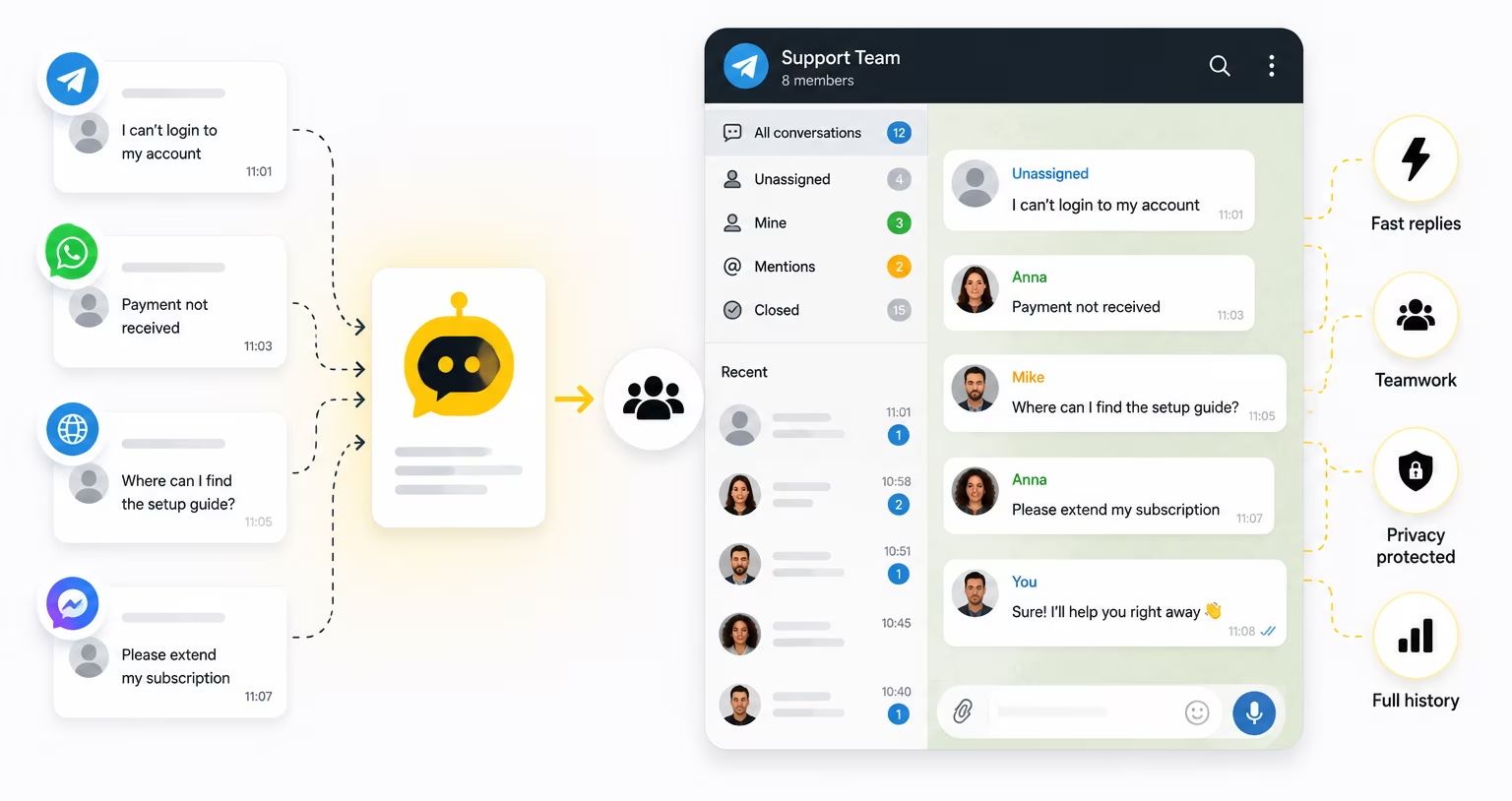
In this model, the customer writes to the service bot, not to a specific person. The team receives the request in a private Telegram group. Customer conversations do not mix with personal chats, and several people can see context and join replies. For the customer, it is simple: they write to support and get an answer. For the team, it becomes a workflow without a heavy CRM interface.
How GramDeskBot helps organize support without a CRM
GramDeskBot fits the middle stage: personal chats are no longer enough, but a large CRM is still unnecessary. A customer writes to your Telegram bot, and the team receives the message in a private group. Employees reply from Telegram without opening a separate complex system. The customer talks to the service bot, not to the owner’s personal account.
The main value is not automation for its own sake. The main value is order. The team gets one place for customer requests. You can add a helper, partner, operator or backup teammate without giving them access to personal chats. If you need to separate personal Telegram from customer support, a bot plus a private group is usually the shortest path.
For digital services, this is especially convenient because many questions repeat. Users ask how to get access, where the link is, why payment failed, how to change a plan, how to connect a new device, why a feature does not work, and what to do after signup. These questions do not need a CRM pipeline. They need a clear entry point, history and a fast reply.
Alternatives to consider
Personal Telegram chats
The simplest option is to keep everything as it is and receive questions in personal Telegram. For the first few customers, this can be perfectly fine. No setup, direct contact, fast answers. The downside appears later: personal Telegram becomes a business tool, customer questions mix with friends, family and contractors, and it is impossible to add another person without sharing a private account.
Spreadsheet and manual statuses
Another common path is a spreadsheet. A customer writes, someone manually adds a row, sets a status and updates notes. On paper, this looks almost like a free CRM. In practice, the spreadsheet goes stale because people forget to update it, while the actual conversation still lives in Telegram, WhatsApp, email or somewhere else.
Website live chat
Website live chat can work well when most customers ask questions while browsing your site. But for a digital service, live chat is not always natural. A user may come back the next day, write from a phone, lose the tab or expect replies in a messenger they already use. If your product already lives around Telegram, bots, subscriptions or quick personal communication, Telegram instead of traditional live chat may be a better fit.
Full CRM or helpdesk
A CRM or helpdesk is the right choice when support becomes a real department. If you have many employees, multiple channels, strict SLA, analytics, templates, roles and escalation rules, use a proper system. But before that stage, do not overcomplicate. A small digital service often needs a normal way to stop losing payment and access questions, not a full customer experience platform.
When a Telegram inbox is enough
A Telegram inbox is usually enough when the service is small, the team is compact, and most support consists of quick questions and clear actions. Users ask about access, payment, setup, renewal, login errors or request status. In these situations, the goal is not to design a perfect CRM architecture. The goal is to see the message and answer.
A simple test helps. If most requests can be solved in one to three messages, and the main pain is “we forget who replied to whom”, it is probably too early to buy a heavy system. If every request requires approval chains, legal documents, cross-department escalation and reporting, then it is time to evaluate a full helpdesk.
What this looks like in practice
Imagine a small subscription service. It has a site, a Telegram channel, a few hundred users and a small team: founder, technical specialist and someone who helps with payments. At first, all questions go to the founder’s personal messages. Replies are fast, but confusion grows: one user did not receive access, another asks for a receipt, a third says “it does not work”, and a fourth asks about renewal.
The team tries a spreadsheet, but it lives separately from conversations. They try replying from different accounts, but customers start writing to the wrong place. They consider a CRM, but realize they do not need deals, pipeline, forecast and a dozen other sections. The better first step is simpler: give customers a support bot link and receive requests in a shared private group.
If there are several services or directions, it is worth planning how to manage support for multiple products or projects before everything mixes in the owner’s personal inbox. That keeps the support channel clear for customers and the context visible for the team.
Conclusion: organize first, add CRM later
Digital service support without a CRM is not about ignoring support. It is a normal growth stage where the team needs order but not yet a heavy system. If requests are already getting lost in personal chats, support should be separated from personal Telegram. If several people answer customers, the team needs a shared inbox. If a CRM feels too large, the problem may still be solvable with a simpler workflow.
A good first step is to give customers a Telegram bot for support and reply from one private team group. You keep the speed of Telegram, but remove the chaos of personal conversations. The customer simply writes to support and gets an answer. The team sees requests in one place and works without a large CRM rollout.
If you are comparing options and want a broader decision guide, continue with support without a heavy CRM and see how small teams avoid CRM and per-agent pricing.
Organize digital service support in Telegram
Connect a bot, invite your team and reply to customers from one private Telegram group without a heavy CRM or per-agent pricing.